
Spring 2026 Design Day
Our Spring 2026 Engineering Design Day event will be held on Wednesday, May 6th, 2026, from 1:00pm-4:00pm in the Viejas Arena.
Design Day is the largest College of Engineering event and it showcases the exciting and innovative design projects that our undergraduate Engineering students conceive, design and build during the academic year. Each Senior Design classes in Aerospace Engineering, Civil, Construction & Environmental Engineering, Electrical & Computer Engineering, and Mechanical Engineering will be participating. 38 projects will be showcased at the 2026 Engineering Design Day event. Below are the Mechanical Engineering Senior Design projects that will be showcased at the event (More details of individual projects will be available as the event draws closer).
Design Day Projects

This project is sponsored by the national non-profit organization, Project S.E.R.V.E. which has the mission of supporting disabled US Veterans and first responders. The project was created in direct support of a disabled US Veteran who had suffered a left leg injury and as the result of the injury, has not been able to ride a bike. The design soluiton provides the Veteran the ability to ride a bike for the first time in many years. The team developed an adaptive pedal allowing full pedal motion and comfortable riding conditions for the disabled veteran.
Team Members: Will Brandenberger, Rolan Abubo, Caleb Ezure, Luis Quiñones, Nikhil Maharaj
ADVISORS
Project S.E.R.V.E.
Scott Huyvaert
RJL Engineering
Ryan Liu
SDSU
Dr. Scott Shaffar

The Automated Synchro Tester is a joint Mechanical Engineering and Electrical & Computer Engineering project sponsored by General Dynamics. The tabletop system autonomously rotates a synchro to specified mechanical angles while measuring the corresponding electrical angle to calculate angular error. Programmed in LabWindows, it reduces test cycle time and operator ergonomic risk. The system integrates precision actuation, sensing, and data acquisition to improve production efficiency, measurement reliability, repeatability, and reproducibility.
Team Members: David Jazo, Joseph Sagmani, Fouad Sabeeh, Sonny Shin, Albert Shamoun, Scott Melton, Ava Halkola, Shomrick Bhadra, Christi Saengsavang
ADVISORS: General Dynamics OTS
Adrian Aldaco
Brandon Pelham
SDSU
Dr. Christopher Paolini
Dr. Scott Shaffar
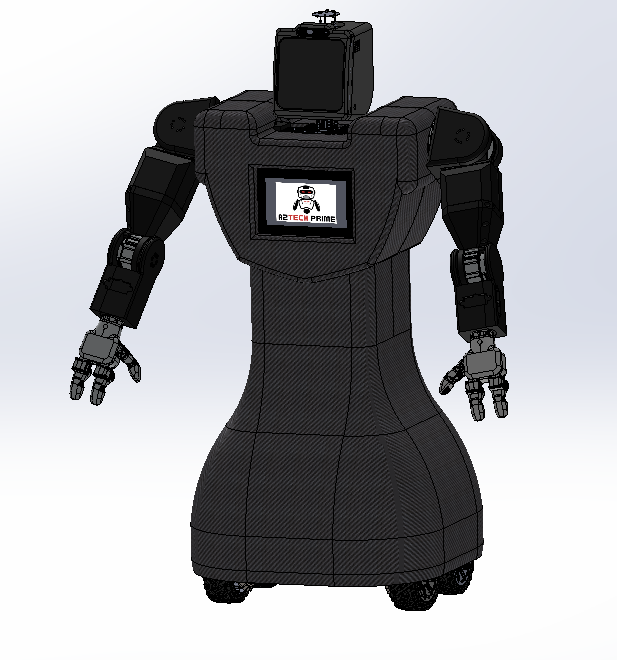
This project is the second phase of the SDSU AI Center’s AztechPrime project. The goal of this project is to design a modular humanoid robot for emotional and social interaction. Phase two of this project focused on reimagining the existing chassis, designing and engineering robust robotic arms, and integrating these changes into the existing system for autonomous movement and interaction with others.
Team Members: Chris Krikorian, Dominic Luscher, Edwin Alvarado
Laith Oraha, Parsa Farahani
ADVISORS: SDSU
Dr. Aaron Elkins
Dr. Christopher Paolini
Dr. Scott Shaffar
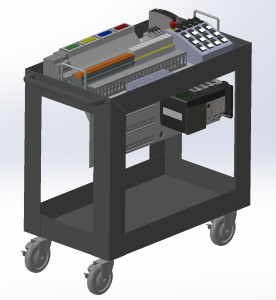
Solar Turbines manufactures gas turbines, compressors, and pump drivers for power
generations and oil & gas markets. Standardized safety control systems are a cornerstone to provide protection from hazards. It includes a PLC-based system and a backup relaysystem working together to bring equipment to a safe position. Training is performed using a simulator bench platform, but the current bench does not reflect the modern hardware. The goal is to design a new simulator aligned with Solar Turbines current hardware and include training documentation.
Team Members: Andrew Russo, Jose Becerra, Alfredo Villegas, Brandon Dominguez
Christian Funke
ADVISORS: Solar Turbines
Ben Hayes
Saliha LaCoursiere
Rachel Wetterlin
Jenny Eyes
SDSU
Dr. Scott Shaffar

Our multidisciplinary team developed an efficient UAV for the California Unmanned Aerial System Competition. This competition requires students to design, integrate, and demonstrate a small uncrewed aerial system capable of waypoint navigation, package drop, package delivery, target identification, and target localization. This competition is organized by California State University and Mojave Air & Space Port at Rutan Field. This competition is points-based, and open to teams of students from universities, colleges, and community colleges. The competition will be held at the Mojave Air & Space Port at Rutan Field on June 7th, 2025.
Team Members: Utku Solmaz, Laith AbouHasoun, Christian Mandigma, Jonah Olsen
Gavin Rask, Rojin Osman, Riley McGregor, Jack Slaten, Ismael Villavicencio, Burak Ozhan, Cristian Rosete, Maxwell Weaver,, Kyle Loutzenhiser, Peter Husch
ADVISORS: SDSU
Dr. Roni Goldshmid
Dr. Joseph Katz
Dr. Christopher Paolini
Dr. Scott Shaffar

Our project strives to create a safer and more efficient 3D printable solid-state electrolyte (SSE) for solid-state batteries. Compared to traditional lithium-based liquid electrolytes, our solid electrolyte uses LLZTO ceramic powder as the main ingredient. We used 3D printing to fabricate complex and stable structures. This created a solid electrolyte that prevents the formation of dendrites and decreases the possibility of toxic leakages and critical failures. The result is an overall safer, longer-lasting battery.
Team Members: Django Piazza, Charlie Ray, Darlene Juat, Maegan Michaela Bolibol
Khoi Le
ADVISORS: SDSU
Dr. Lingping Kong
Dr. Scott Shaffar
Dr. Yang Yang

Chemical vapor deposition (CVD) is a vacuum-based process used to fabricate conductive polymer thin films. Sponsored by the Advanced Manufacturing for Energy Devices (AMED) Laboratory, this project aims to complete two systems: an oxidative CVD reactor and an initiated CVD reactor. Both systems incorporate a pressure transducer, throttle valve, and PID control algorithm to regulate base and process pressures using a Leybold vacuum pump. Additionally, a vapor shield is designed and fabricated to improve deposition rates and precursor yield in the oCVD reactor.
Team Members: Naomi Chuang, Ella Helge, Connor Malech, Zack Melland, Alex Christiansen
ADVISORS: SDSU
Dr. Meysam Heydari Gharahcheshmeh
Dr. Scott Shaffar

This is a project sponsored by the General Atomics Electromagnetics Group. The project involves the design, prototype build and test of a light-weight thermal control valve—known as a valve mixer. A valve mixer is a mechanical device that controls fluid temperature by blending fluids of different temperatures to provide consistent and precise fluid temperature and control.
Team Members: Jaden Li, Noah Deneau, Natalie Puspos, Nicolas Doutt, Emanuel Diaz-Sanchez, Aidan Kiswoto, Sara Hilera, Merabi Khachidze, Tarun Nair
ADVISORS:
General Atomics Electromagnetics
Systems Group
Vidyashankar Rangaswamy
Travis Scott
SDSU
Dr. Christopher Paolini
Dr. Scott Shaffar

This project focuses on key plasma diagnostic systems for General Atomics’ DIII-D SupRISE Test Stand, which utilizes an RF-inductively generated ion source to replace the current arc-filament system on the tokamak. The Plasma Eater diagnostic system and Faraday shield developed as part of this project are intended to enable the SupRISE Test Stand to operate at higher power levels while providing more accurate and reliable data acquisition of desired plasma parameters.
Team Members: Avery Buehler, Robert Adams, Jake Hooper, Khaled Mohaisen, Krista Patel, Daniel Self, Clayton Alvarez, Jimin Chae, Son Huynh, Ulises Urbina
ADVISORS:
DIII-D National Fusion Facility
Dr. Brendan Crowley
Evan Kallenberg
SDSU
Dr. Christopher Paolini
Dr. Scott Shaffar
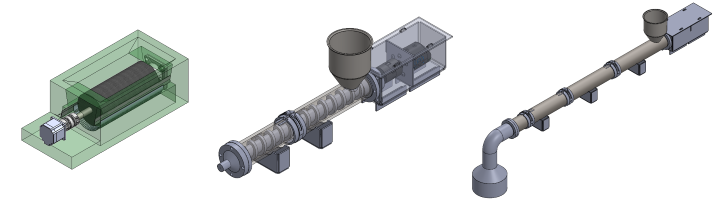
Design and Prototyping of a Lunar-Compatible Nomex-Nylon Recycling System for Additive Manufacturing
Our project takes in waste products from a theoretical long-term space mission and recycles them into a robust 3D-Printer filament. It does this by mixing liquid thermally separated thermoplastics with a blend of shredded Nomex fibers. The separated thermoplastic and nomex are mixed into a hopper to be moved through a filament barrel and screw system to an extrusion die. The system has potential for application support Lunar missions.
Team Members: Brandon Dimmick, Jacob Manzanares, William Menigoz, Rocky Kemper, Kurtis Ramsey, Meredyz Anzalado
ADVISORS: SDSU
Dr. Marta Miletic
Dr. Scott Shaffar

The goal of this project is to create a novel induction system that is solenoid-like and that will be able to melt metal powders within a few nano to micro seconds. This heat induction system uses an Electro-Nano-Pulse (ENP) power supply to generate a recurring current with each pulse at a specific frequency, which generates a changing magnetic field that produces sufficient heat to reach near the metal powder’s melting point.
Team Members: Khattab Ramadhan, Antonio Solis, Jena Leia Hernandez, Kevin Vu, Justin Nedd, Thu Vu, Arturo Galeana
ADVISORS: SDSU
Dr. Christopher Paolini
Dr. Scott Shaffar
Dr. Wenwu Xu
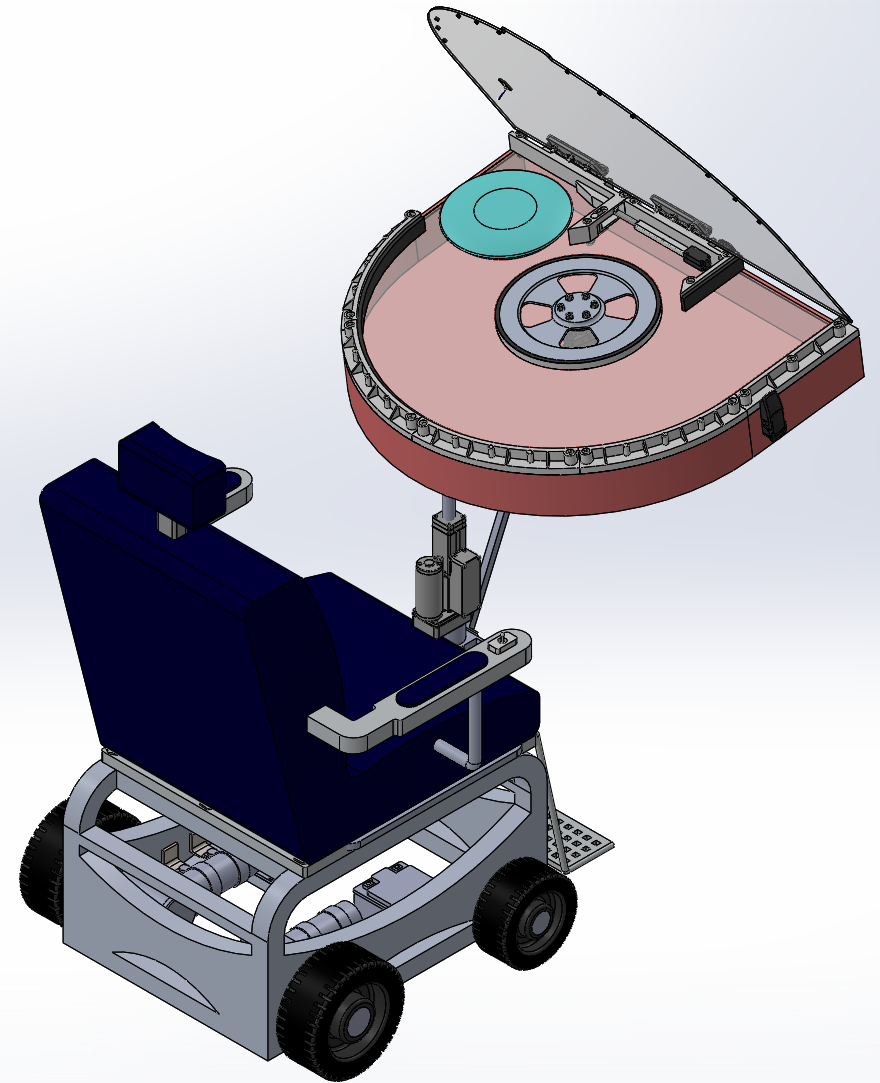
This detachable wheelchair-mounted disc golf launcher was built to allow quadriplegic veterans to participate fully in the game of disc golf. It enables users with limited mobility to safely and accurately launch a disc at their desired power and angle using accessible controls. The launcher promotes inclusivity, independence, and competitive play, and will be used in the National Veterans Wheelchair Games this summer.
Team Members: Maddox Curley, David Aguilar, Cody Marinshaw, William Salsberg, Miral Ahmed, Andrew Gamez, Devan Mayer, John Hayali, Juan Cruz, Hadi Alwakeel
ADVISORS:
PVA
Louis Irvin
SDSU
Dr. Christopher Paolini
Dr. Scott Shaffar

This project focuses on designing an in-circuit testing fixture that integrates mechanical and electrical components to test the functionality of PCBAs that are to go into hospital grade medication dispenser. The fixture performs a bed-of-nails test on the PCBA by clamping it securely and sending electrical test signals to the PCBA using spring loaded electrical test probes.
Team Members: Jacob Butcher, Samantha Castellanos, Kaye-Angeli Delacruz, Edgardo Gonzalez-Galvez, Kylyn Hoover, Sarah Hsu, Trek Hugg, Brandon Nguyen, Mia Sevidal, Brett Wimmer
ADVISORS:
BD
Scott Freemen
Hossein Khadiri
SDSU
Dr. Scott Shaffar
Dr. Christopher Paolini
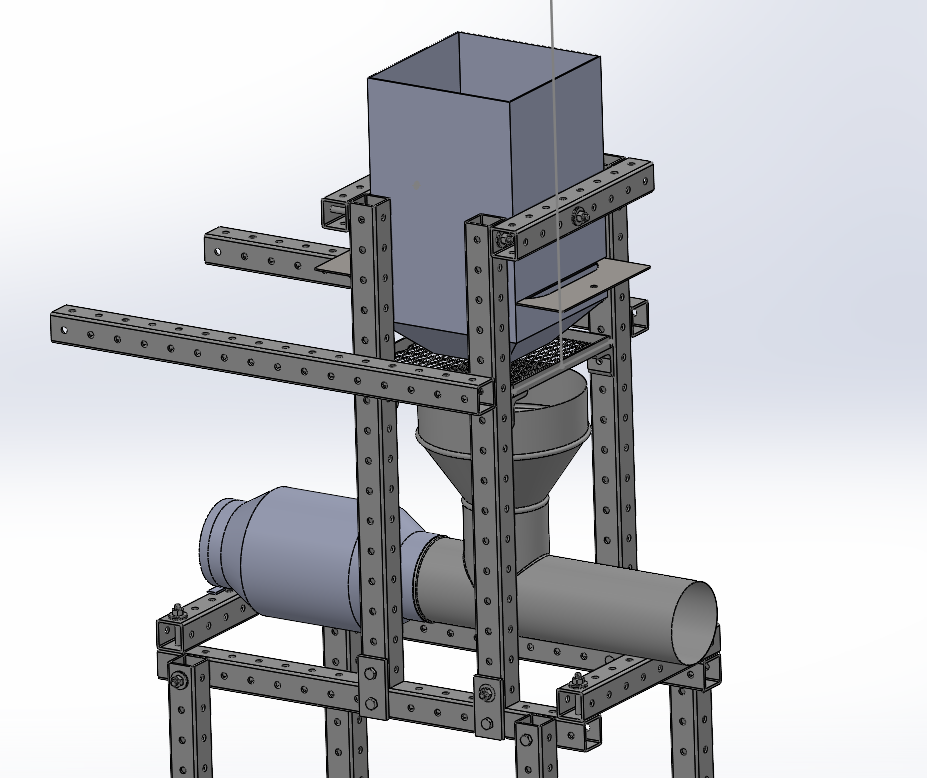
Our team developed an ember generator for wildfire research to replicate how embers behave at varying wind speeds. The system burns fuel inside an combustion chamber to produce embers and they flow into a wind tunnel with an integrated fan that directs them at controlled speeds in a desired direction. Designed to be compact and portable, the device allows for safe, repeatable testing. This project supports research on fire risks to vegetation and structures in Wildland-Urban Interface (WUI) communities, helping advance wildfire safety strategies.
Team Members: Krystal Morera, Ronin Toy, Tyson Chavez, Mike Khuu, David Gray
ADVISORS: SDSU
Dr. Luca Carmignani
Dr. Scott Shaffar

Due to increased production demand for high-output gas turbines driven by the data
center boom, Solar Turbines required additional hydrostatic leak-testing capacity to support increased fuel injector production throughput. This project included the design, fabrication, and validation of a new hydrostatic leak-test bench featuring a 10 gallon pressure vessel rated for 300-psi testing to verify fuel-injector brazed joints.
Team Members: Case Spencer, Carson Loucks, Christiaan Marringa, Juan Mateos, Gavin Vance
ADVISORS
Solar Turbines
Sergio L. Lopez
Ernesto Portillo Jr.
Matt Ostiguy
SDSU: Dr. Scott Shaffar

This project focuses on the design of a modular pylon capable of supporting multiple payload configurations for the MQ-9, a multi-role remotely piloted aircraft. A pylon is a wing-mounted structure used to carry external stores. The design must integrate mounting provisions for two Line Replaceable Units (LRUs) and support two payload carriage systems: an expanded Bomb Rack Unit (BRU) with both 14-inch and 30-inch lug spacing, and a Missile Rail Launcher (MRL) with 30-inch mounting holes. A scaled prototype was manufactured in order to validate
the design.
Team Members: Wynter Trumpfheller, Jake Finn, Emiliano Mondragon Flores, Justin Tong, Nathan Weast
ADVISORS:
General Atomics
Aeronautical Systems
Christopher Aguilar
Christopher Sam
Eshan Sinha
General Atomics
Aeronautical Systems
Tallon McDonough
Kris Russel
SDSU
Dr. Scott Shaffar

This sponsored project with General Atomics Aeronautical Systems focuses on designing, building, and testing an optimized aircraft propulsor that improves efficiency and reduces noise compared to a provided baseline propeller. An interdisciplinary student team developed the propulsor and a dedicated testbed to compare thrust, efficiency, and acoustic performance using off-the-shelf sensors and data acquisition systems, demonstrating measurable advancements in quiet, efficient propulsion technology.
Team Members: Patrick Ibarra, Erik Ramirez, Fraser Meagher, Jacob Schuch, Dawson Gregg, Omar Aviles, Randy Figueroa, Isabella Segovia, Kohki Kita, Julio Bravo, Jackson Tuday, Kiara Bolden
General Atomics
Christopher Sam
SDSU
Dr. Roni Goldshmid
Dr. Joseph Katz
Dr. Christopher Paolini
Dr. Scott Shaffar

The Human Cooler project designs a wearable personal cooling device that is capable of shedding enough heat to allow the user to perform activities of moderate to high levels of physical exertion while maintaining a core body temperature of 100.4°. This device is applicable to those who are required to perform strenuous physical activity in environments with extreme heat in order to help prevent these individuals from developing heat related illnesses.
Team Members: Megan Kojima, Ian Mexas, Madeline MacDonald, Serena Nguyen, Calvin Viriyavong, Joshua Arjona, Chelsey Manlangit, Nate Muttera, Nolan Conrad, Micah Davis
ADVISORS:
HTE
Ken Arnold
SDSU
Dr. Christopher Paolini
Dr. Scott Shaffar

This project involves the design, fabrication and test of an induction welder for joining thermoplastic composites, specifically carbon fiber-reinforced PEKK polymers. The induction welder is planned to be capable of welding plates (or curved cylindrical panels)from 4 plies to up to 32 plies thick (0.5 mm to 4 mm) and with dimensions of 30 cm x 30 cm. The induction welding head uses a pancake-type coil, which moves along the weld region in the x-y plane at a specified distance from the plate. For curved panels, the welding coil includes xyz translation.
Team Members: Christian Miller, Matthew Richard, Ryan Pursel, Elliot Berman, Abby Gittings, Andrew Margo, Abel Estrada-Martinez
ADVISORS: SDSU
Dr. Christopher Paolini
Dr. Scott Shaffar
Dr.Satchithanandam Venkataraman

Team ATHENA (Aztec Technology for Harvesting, Exploration, and Navigation in Astro-mining) is representing SDSU in the NASA Lunabotics 2026 Competition. The team is tasked with the design and build of the payload systems for a telerobotic rover capable of traversing, excavating, transporting, and depositing lunar regolith. This supports NASA’s Artemis missions to use in-situ resources for lunar construction. ATHENA will travel to Kennedy Space Center and UCF to compete in a simulated deployment lunar mission against other universities.
Team Members: Anil Mahadeo, Daniel Campos, Shane Turner, Jeffrey Lin
Nicolas Ulloa
ADVISORS: SDSU
Dr. Christopher Paolini
Dr. Scott Shaffar
Dr.Satchithanandam Venkataraman

Team ATHENA (Aztec Technology for Harvesting, Exploration, and Navigation in Astro-mining) is representing SDSU in the NASA Lunabotics 2026 Competition. The team is tasked with the design and build of the propulsion, navigation, control system for a telerobotic rover capable of traversing, excavating, transporting, and depositing lunar regolith. This supports NASA’s Artemis missions to use in-situ resources for lunar construction. ATHENA will travel to the University of Central Florida and Kennedy Space Centerto compete in a simulated deployment lunar mission against other universities.
Team Members: Giovanni Diaz-Lopez, Gio De Guzman, Satya Sai Nagarjuna Varma
Nampalli, Bailey Morgan, Kai Pichay, Oscar Sou, Jacob Ibay, Charmay Hoang, Ava Aiken, Gecsan Reyes
ADVISORS: SDSU
Dr. Christopher Paolini
Dr. Scott Shaffar

This project involves creating a mechanically steered high frequency antenna on a gimbal assembly for use with drone operations. The design will allow for a smaller antenna with a narrower beam to provide a high gain as compared to prior solutions. This is designed to be used on commercial off the shelf drones, and is designed with the intentions of being used in jammed environments.
Team Members: Frederick Brinkman, Jon Dietz, Edson Mosqueda, Hailey Zema
Mark Tran, Noah Gist, Kristof Balasanian, David Aragon, Tomas Blatchley, David Schnack
ADVISORS
Naval Information Warfare Center Pacific
Randall Olsen
SDSU
Dr. Christopher Paolini
Dr. Scott Shaffar

Solar Turbines is looking to eliminate the custom wood frames currently used to transport the company’s machinery. The proposed modular tarp support structure design solution uses modular steel supports arranged as an adaptable frame system designed to support and secure a tarp over non-enclosed packages of varying geometry. The primary function of the design is to provide physical support, preventing tarp sagging, ensuring weather protection, and improving overall stability during storage or transport. This aims to eliminate the use of custom wooden frames and replace them with standardized parts.
Team Members: Alicia Olvera, Gloria Martinez Orozco, Jane West, Mitchell Brimhall
Victor Duran
ADVISORS
Solar Turbines
Jim Hickle
SDSU
Dr. Scott Shaffar

This project’s goal is to design and construct a single flow-cell test chamber for testing multiple gas sensors simultaneously. The chamber accomodates an array of gas sensors. A data acquisition (DAQ) system is incorporated to collect the electrical output from each sensor channel and transmit the measurements to a computer interface, where the real-time data is displayed on a screen for monitoring and recording.
Team Members: Peter Kodheli, Karam Alshaikh, Zachary Cartwright, Aaron Goldis
Brayand Perez, Christopher Westover, Kayla Hicks, Zaiver Ayarza, Andraws Yaqo
Keith Andrew Quiambao
ADVISORS
AtmoSense
Dr. Mike Frank
SDSU
Dr. Christopher Paolini
Dr. Scott Shaffar
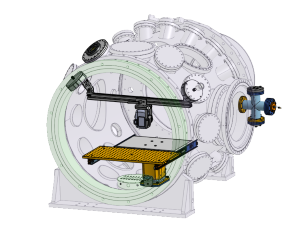
This project involved the design and integration of an in-vacuum, externally actuated Z-stage with precise vertical and horizontal motion for repeatable sample positioning under vacuum. The system includes a high resolution internal digital camera for visual monitoring and an external thermal camera for temperature mapping through an IR transparent viewport. Together, the platform enables stable, non intrusive visualization and thermal analysis of tin hydrogen interactions without breaking vacuum.
Team Members: David Klunder, Tomas Puente, Clayton Messick, Luke Peters
Zachary Dietderich
ADVISORS
ASML
Kent Bruzzone
Mike Perry
Joshua Malowney
SDSU
Dr. Scott Shaffar

This project focused on improving the aerodynamic performance of Ron Fletcher’s Revolution 500 SC race car. The team analyzed the existing rear wing geometry, developed CAD models, and performed FEM structural analysis and CFD aerodynamic simulations. Three carbon-fiber rear wings and two front splitter flaps were designed and manufactured, along with custom mounting hardware to integrate them onto the vehicle. Performance improvements were validated through on-track testing overall reducing lap times.
Team Members: Shaun Preston, Charlie Webb, Theodore Pierce, Jacky Liu, Sammy Parsley, Xander Vivo, Sofia Goulart, Lucas Wilkins, Grace Martin
ADVISORS: SDSU
Dr. Roni Goldshmid
Dr. Joseph Katz
Dr. Scott Shaffar

This project focuses on developing high voltage, fast charging lithium ion batteries with improved safety and extended lifespan. Our team will synthesize and characterize advanced cathode and anode materials, analyze Li ion transport and interphase stability, and fabricate coin and pouch cells. Performance targets include high energy and power density, strong capacity retention at up to 10C, and successful demonstration of a 20 mAh bipolar stacked pouch cell.
Team Members: Daniel Butron, Nicholas Ferry, Preston Kwok, William Moxley, Nathaniel Sweitzer
ADVISORS: SDSU
Dr. Lingping Kong
Dr. Scott Shaffar

This project involves the design and fabrication of a reusable transport structure for safely shipping turbomachinery enclosure roof panels between manufacturing facilities. The new system replaces an existing method that created oversized loads, increasing cost and logistical complexity. The team developed a welded steel A-frame structure that supports multiple panel sizes at a fixed angles, improving transport efficiency, reducing damage risk, and supporting sustainability through a durable, reusable packaging solution.
Team Members: William Bryan, Giacomo LaLicata, Ryan Morris, Owen Neylon, Tanner Renken
ADVISORS: SDSU
Dr. Lingping Kong
Dr. Scott Shaffar

The robotic palm trimmer end effector replaces manual palm trunk trimming to improve safety and ease. It features an improved circumferential track system and a radial positioning stage that has a 360° reach around the trunk to cut fronds. The trimmer integrates with the Robotic Palm Elevator that operates through a shared controller and power source. The elevator moves vertically via a joystick control while maintaining constant arm tension as it performs the cutting process.
Team Members: Alyssa J De La Torre, Andres Santos, Christian Montano, Lukas Hruza, Esha Lata Ram, Kanji Hirayama, Daniel Cueva, Coltin Haniotakis, Kevin Lee
Niccolas Armenta
ADVISORS:
Max Engineering
Max Winiarz
SDSU
Dr. Christopher Paolini
Dr. Scott Shaffar

In partnership with the Powder Technology Lab on campus, Laser Layers was tasked with developing a controllable, lab-based solar selective laser sintering (SLS) printer, which could lead to efficient manufacturing both on earth and extraterrestrially. Solar SLS printing offers a unique opportunity to advance research at the interestion of additive manufacturing and renewable production through the development of a controlled platform and solar simulator.
Team Members: Collin Archer, William Kim, Justin Perry, Jericho Raguine, Kimberly Telleson
ADVISORS: SDSU
Runijan Jiang
Dr. Scott Shaffar
Zackary Skinner
Dr. Elisa Torresani

Solid-State Plasticized INterlayer Additive Manufacturing (SPIN-AM) enables the solid-state joining and formation of steel components through friction-generated heat. Using a CNC-driven rotating tool, SPIN-AM plastically deforms and consolidates a steel substrate without melting the base material, reducing defects commonly associated with traditional welding processes. The project focuses on tool geometry development, process parameter optimization, and controlled material flow to enable repeatable fabrication of large-scale structural components.
Team Members: Seth Peraza, Sam Kaplan, Kea Mok, Suzette Lorenzo Zarate, Joseph DeGroot
ADVISORS: SDSU
Dr. Patrick Kwon
Dr. Scott Shaffar

In collaboration with Solar Turbines, Team Heavy Metal has developed steel frame bases that can support their Titan 130 and Titan 250 series of turbomachinery packages, which weigh between 80,000 and 140,000 pounds. The team’s robust, streamlined designs are optimized for in-house manufacturing rather than outsourcing, thereby significantly reducing production costs and lead times for the company.
Team Members: Ahmet Mutafoglu, Jose Elizalde, Justin Stillwagon, Matthew Brinkmeier, Ryan Pors
ADVISORS
Solar Turbines
Antonio Jimenez
Jim Hickle
Aileen Fahme
SDSU
Dr. Scott Shaffar

To help the Loisaba Conservancy in Kenya with their mission to monitor black rhinos, a low- power, solar-powered, AI trained, LoRa capable camera system has been designed, fabricated and test providing the ability to send alerts when the rhinos are spotted. The system sends a picture and the location data to the Conservancy staff providing them data on the best locations to observee the rhinos. The system includes an enclosure rated an IP67 and includesthe option to be mounted to either a tripod or trees.
Team Members: Aliza Siddiqui, Amelie Salas, Abdullah Dost, John Flores, Ryan Hovan, Joshua Lange, Brent Mullins, Ethan Quach, Jonathan Wessel, Jadyn Yamashita
ADVISORS
San Diego Zoo Wildlife Alliance
Katie Garwood
SDSU
Dr. Christopher Paolini
Dr. Scott Shaffar

Flame-retardant structures have gained attention in the industrial, aerospace, and thermal power fields due to their resistance to extreme high-temperature exposure, yet designing protective materials with complex geometries remains challenging. This project develops a 3D-printed, bioinspired flame-retardant composite that mimics nacre’s brick-and-mortar architecture. Boron nitride–reinforced composites are fabricated and evaluated through thermal and mechanical testing to improve heat resistance and impact performance for advanced fire-protection equipment.
Team Members: Jakob Bradley, Julia Hong, Alex Kownacki, Dylan Alves, Ian Greer
ADVISORS: SDSU
Dr. Scott Shaffar
Dr. Yang Yang

The California 3D Printed Aircraft Competition (C-3DPAC) challenges teams to design, build, and fly a remote-controlled aircraft with significant 3D-printed components. Emphasizing innovation, aerodynamics, and additive manufacturing, teams must optimize weight, strength, and design to excel within competition constraints. Aircraft undergo design reviews, flight tests, and performance evaluations, including the core trial of longest flight time. The competition fosters engineering skills, teamwork, and practical application of additive manufacturing and design.
Team Members: Gilbert Trinh, Mitchell Prokey, James Cook, Ameko Birdsall
Paul Kauvaka, Anthony Anderson, Wyatt Charette, Dario Bautista, Natalie Windsor
Rina Alkoblan
ADVISORS:
Dr. Charles Norris
SDSU
Dr. Roni Goldshmid
Dr. Joseph Katz
Dr. Scott Shaffar

The California State University 3D Printed Aircraft Competition invites teams to design, build, and fly an aircraft fabricated with 3D-printed parts. The competition focuses on innovation and aerodynamics. Teams must balance weight, strength, and design elements while maximizing performance. Aircraft are judged via design reviews and performance evaluations, with the challenge being to achieve the longest flight time. Participants will develop their engineering knowledge, teamwork skills, and gain hands-on experience in additive manufacturing and aircraft design.
Team Members: Caitlin Kuehn, James Romero, Loc Nguyen, Max Fromkin, Adam Asuelo, Hussein Aljebur, Iris Kashirsky, Shezreen Kahn, Saya Kimura, Joshua Laurain
ADVISORS
Dr. Charles Norris
SDSU
Dr. Roni Goldshmid
Dr. Joseph Katz
Dr. Scott Shaffar

The California 3D Printed Aircraft Competition (C-3DPAC) challenges teams to design, build, and fly a remote-controlled aircraft with significant 3D printed components. Emphasizing innovation, aerodynamics, and additive manufacturing, teams must optimize weight, strength, and design to excel within competition constraints. Aircraft undergo design reviews, flight tests, and performance evaluations, including the core trial of longest flight time. The competition fosters engineering skills, teamwork, and practical application of additive manufacturing and design.
Team Members: Jasmine Timnak, Noah Graf, Jose Lopez, Andy Nguyen, Anand Berg, Brenna Rao, Corey Mcinvale, Brennan Fogleman, Cole Bergren, Joshua Toledo
ADVISORS
Dr. Charles Norris
SDSU
Dr. Roni Goldshmid
Dr. Joseph Katz
Dr. Scott Shaffar
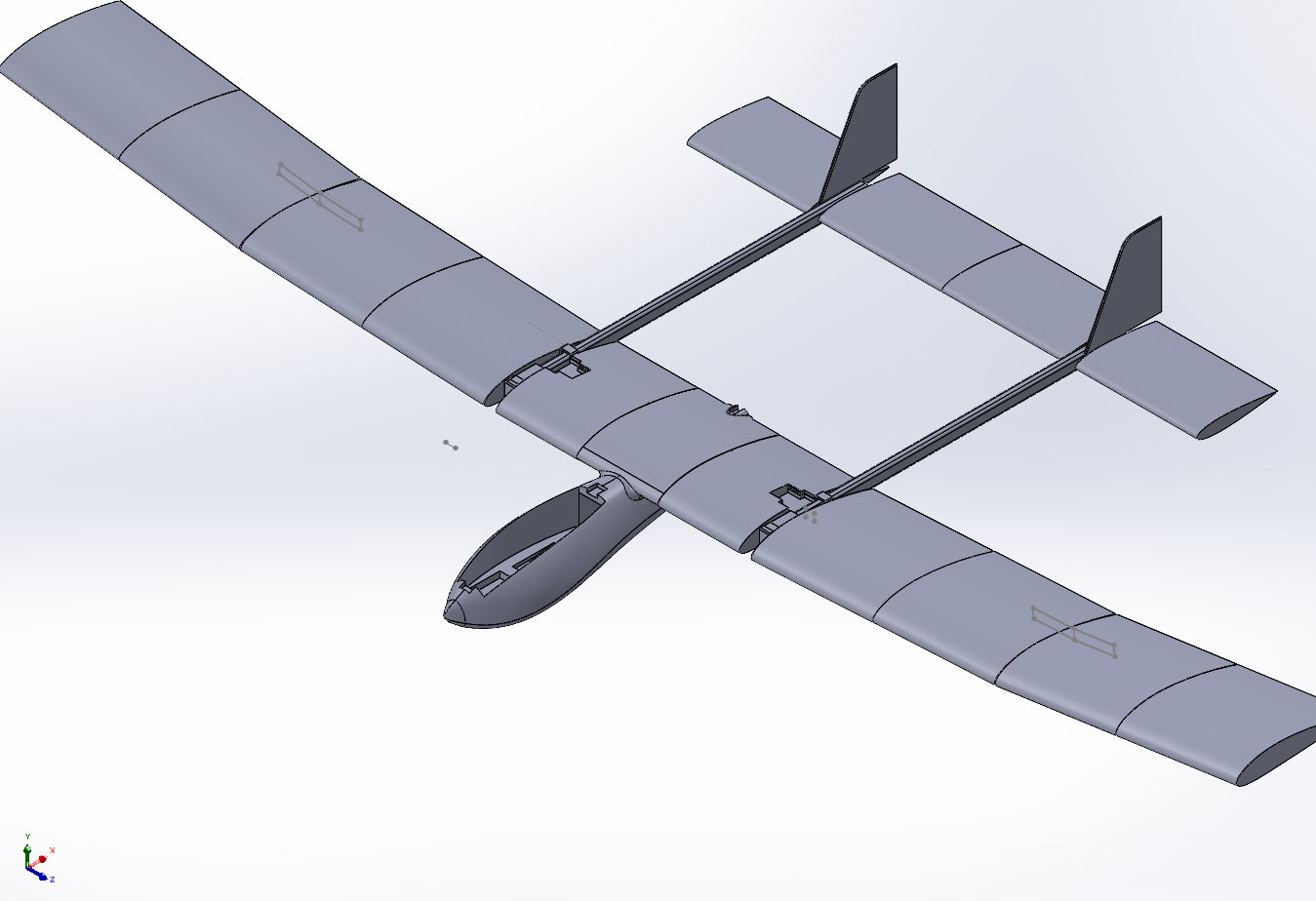
The California 3D Printed Aircraft Competition (C-3DPAC) challenges teams to design, build, and fly a remote-controlled aircraft with significant 3D-printed components. Emphasizing, innovation, aerodynamics, and additive manufacturing, teams must optimize weight, strength, and design to excel within competition constraints. Aircraft undergo design reviews, flight, tests, and performance evaluations, including the core trial of longest flight time. The, competition fosters engineering skills, teamwork, and practical application of additive, manufacturing and design.
Team Members: Joshua Cain, Alan Brockmeyer, Jack Wise, Kole Christoff, Corbin Paull, Andrew McGlynn, David Maturin, Hayden Schmehl, Brendan Scharmann
ADVISORS
Dr. Charles Norris
SDSU
Dr. Geoffrey Butler
Dr. Scott Shaffar